Why Your HVAC Company's Reviews Matter More Than Your Star Rating (And What to Do About It)
Andy Harris · November 9, 2026 · 9 min read
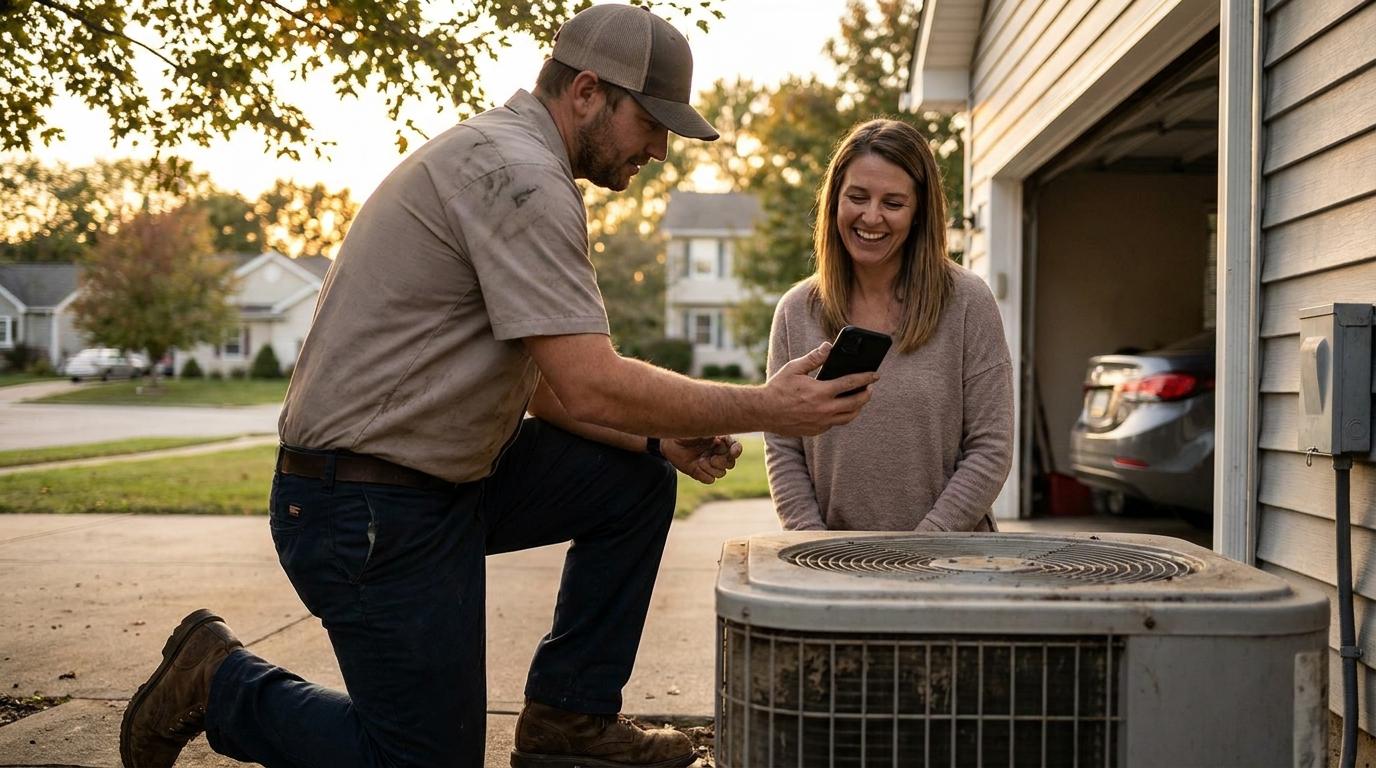
Yes, reviews matter more than your star rating. A high rating gets you considered, but the words inside your reviews decide who gets the call. Recent, specific reviews that name the problem, the town and the technician tell a homeowner you are real. As free search clicks shrink, those reviews do more of the selling.
Do reviews matter more than my star rating?
Mostly, yes. A star rating is one number, and every serious competitor already has a good one. Reviews are the evidence behind it. A homeowner with a dead furnace reads the actual words, checks how recent they are, and calls the company that sounds like it shows up. The stars get you on the shortlist. The text closes the call.
Think about how you shop when something breaks. You do not stop at the number. You scroll for the one review that sounds like your situation.
That is what your customers do too. If your last ten reviews all say "Great service!" and nothing else, you look the same as everyone else. If they say "AC died on a Saturday in July, tech was there by noon," you look like the company to call.
What does a travel company's earnings call have to do with HVAC?
Tripadvisor is a business built on reviews, and its latest quarter shows what happens when Google sends fewer free clicks. According to Matt Southern at Search Engine Journal, it took a $369.5 million writedown tied largely to traffic headwinds from changes in search.
Your HVAC company is a lot smaller than Tripadvisor. The pressure still points the same way.
Southern reports that Tripadvisor's CFO said SEO will still be a headwind to growth in 2027. He also reports that marketing took 48.8% of revenue from continuing operations in the third quarter, up from 43.3% a year earlier. Tripadvisor ties that to a move from free channels to paid ones.
Here is my read for a contractor. When free traffic gets harder to count on, the cost of getting a lead goes up. You can pay more for clicks, or you can make sure every person who does find you has a reason to pick you. Reviews are the cheapest reason you can build.
I am not saying your HVAC website traffic will fall like a travel site's. I am saying you should not build your business on the assumption that search will keep sending the same traffic it always has.
Why do reviews matter more when Google sends fewer clicks?
When fewer people click through to websites, more decisions happen on the search results page itself. The homeowner sees your name, your rating and a few review snippets, and often calls from there. Your reviews become your sales pitch, shown before anyone reads a word on your site.
That shift is why I tell owners to stop obsessing over the number and start looking at the content.
Ask yourself three things:
- Are my newest reviews from this month, or from last year?
- Do they describe real jobs, like a no-heat call, a repair, or a replacement?
- Do they mention the town or neighborhood I want more work in?
If the answer to those is no, your rating is doing less for you than you think. A homeowner who sees a review from eleven months ago wonders if you are still in business, or if the crew changed.
You can see where you stand with the free Local Visibility Score. It checks how your business shows up in local search, and reviews are part of that picture.
What should HVAC reviews say besides five stars?
The best HVAC reviews name the problem, the service and the person who did the work. Detail makes a review believable, and it matches the words homeowners type into search. "Furnace stopped working, tech diagnosed it quickly and explained the repair" beats "Awesome company" every time.
Here is what a useful review tends to include:
- The problem. No cooling, no heat, strange noise, a high bill.
- The service. Repair, tune-up, install, or replacement.
- The location. The town or neighborhood, if the customer is willing to say it.
- The person. The technician or office staff member by name.
- The experience. On time, clear price, cleaned up after.
You cannot write reviews for customers, and you should not try. What you can do is make it easy for them to say more than "great job."
If you want a quick look at how to ask, this short video covers getting Google reviews for an HVAC company, and it is worth three minutes before you change your process.
How do I get more detailed HVAC reviews?
Ask every customer, ask right after the job, and make the review link one tap away. Detailed reviews come from a fresh memory and a simple request. The longer you wait, the shorter and vaguer the review gets, and the more likely it never gets written.
A process that works for a busy shop:
- Ask on site. The technician says, "If we did a good job today, a quick Google review really helps us."
- Text the direct link. Send it before the truck leaves the driveway. Do not make people search for your business.
- Give a gentle prompt. A line like "Tell people what was wrong and how we fixed it" gets better content than "Please leave a review."
- Ask on every job. Not just the ones you think went well. A steady flow looks real. A burst of twenty reviews in one week looks odd.
- Reply to each one. Thank the customer and mention the job in plain words, such as "Glad we got your AC running before the weekend." Your reply is more text on your profile.
- Count monthly. Write down how many new reviews you got. If the number is zero, fix the process, not the rating.
Do not offer discounts or gifts for reviews. It breaks the platform rules, and customers can tell.
If you are not sure what your profile looks like from a homeowner's side, the Google Profile Audit is a good place to start.
Do reviews matter for AI search tools like ChatGPT?
Probably, and the early signs are worth watching. On Tripadvisor's earnings call, CEO Matt Goldberg said he believes AI platforms value the content its contributors create, treating it as citations. The same article reports that AI is probably under 1% of Tripadvisor's traffic, but ramping.
That is a travel company, and I would not stretch the numbers to HVAC. But two details are worth knowing.
First, Southern reports Goldberg thinks AI traffic converts at close to five times the average on Viator and about twice the average on Tripadvisor. Small volume, but those visitors showed up further along in their decision.
Second, the content that AI tools lean on is the kind real customers write: specific, detailed, in plain language. That is the same kind of review that wins a human reader.
So you do not need a separate plan for AI. You need real, recent, detailed reviews, and a profile that is complete and consistent. You can check how your business appears to AI assistants with an AI visibility report.
What should I do this week?
Start small: read your last ten reviews as if you were a stranger, fix your ask process, and answer every unanswered review. That takes an hour or two and costs nothing. It makes your existing leads more likely to turn into booked jobs.
Here is the short list:
- Read your ten newest reviews. Note how many name a problem, a service or a town.
- Save your direct Google review link in every technician's phone.
- Reply to any review you have not answered, starting with the newest.
- Set a monthly target for new reviews and track it.
None of this is exciting. It works because most of your competitors are not doing it consistently.
Common questions
How many reviews does an HVAC company need?
There is no magic number. What matters is that you have more recent, detailed reviews than the other companies a homeowner is comparing you with. A steady flow of new reviews every month beats a big pile from two years ago. Keep asking after every job.
Should I reply to negative reviews?
Yes. Reply calmly, briefly and without arguing. State what you will do to fix it and offer to talk offline. Future customers read how you handle a bad day more closely than they read the complaint itself. A professional reply often helps you.
Is a perfect five-star rating good?
Not necessarily. A rating that looks too perfect can make people skeptical, and it is not something to chase. Focus on honest reviews with real detail. A few bumps, answered well, make your profile look more believable than a spotless record.
How often should I ask for reviews?
After every completed job. Make it part of the routine, like writing the invoice. Consistent asking gives you a steady stream of fresh reviews, which tells homeowners you are active and working right now.